
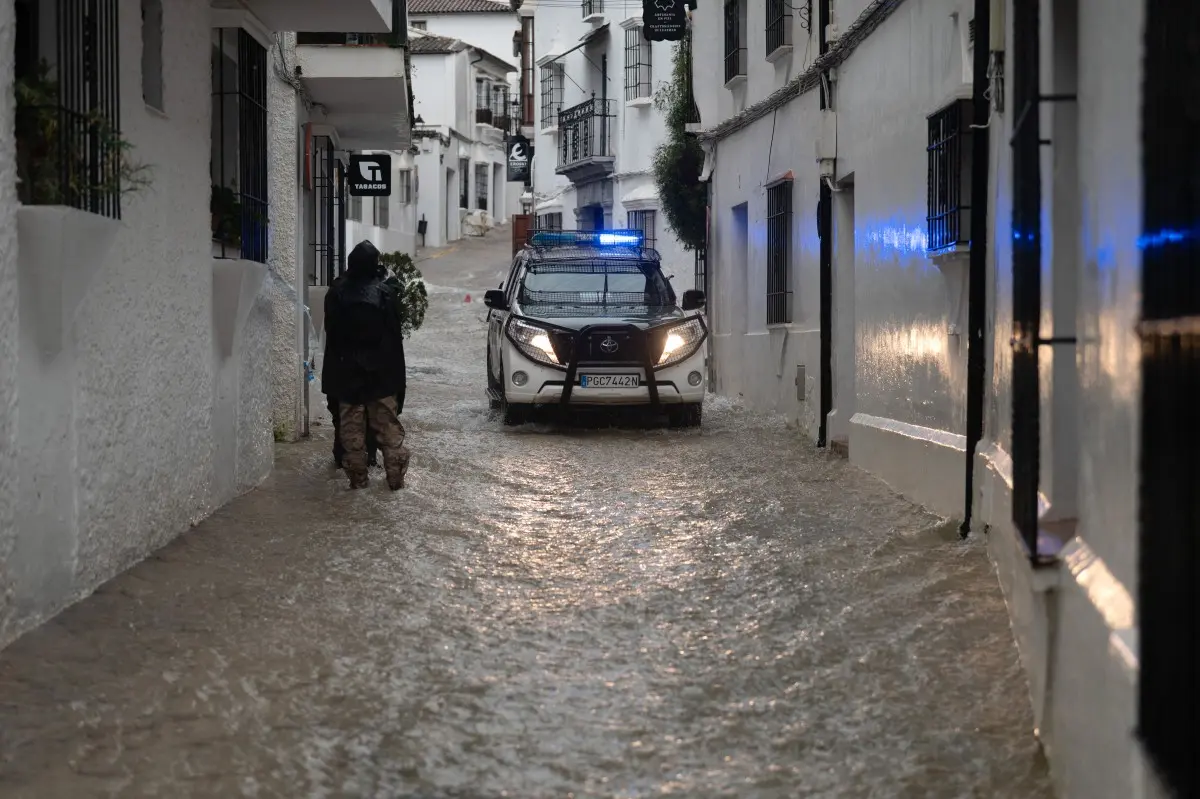
Storm Leonardo has flooded swathes of Andalusia, causing evacuations across the southern region and leaving the rest of Spain on weather alert.
The seventh major storm to hit the Iberian peninsula this year left more than 40 centimetres (15 inches) of rain in some districts. In Cádiz province, the storm dropped 800 litres per square metre on the town of Grazalema.
READ ALSO: Why is Grazalema the rainiest place in Spain?
Videos posted on social media showed water coming out of plug sockets and seeping through the walls of homes in this small mountainous town, with waterfalls forming on nearby cliffs and some properties destroyed by landslides.
The town's 2,000 inhabitants were all evacuated on Thursday afternoon.
The highest level storm alert, however, has Thursday been lifted in Andalusia on Thursday, but orange wind warnings remain in Almería, Córdoba, Granada and Jaén.
Yellow-level rain warnings remain active in Cádiz, Jaén and Málaga, where significant damage was caused by the downpours, such as at Chipiona beach in Cádiz.
READ ALSO: What do Spain's orange and red weather alerts mean for the public?
In the rest of the region, yellow warnings predominate, with special attention to the strong waves along the Andalusian coast.
Flooding caused by storm Leonardo has forced around 4,000 people to be evacuated across the southern region, where more than 7,000 weather-related incidents were recorded, none of them causing serious damage.
One person was injured in a building collapse, local media reports suggest, and a search is underway for a woman missing in Sayalonga, Málaga province, after she fell into the Turvilla River.
The downpours have also cause problems at airports in Andalusia.
Five flights due to land at Málaga-Costa del Sol Airport had to be diverted to airports in other regions due to the strong crosswinds.
Cancellations are also now affecting three Andalusian airports: Málaga, Granada and Jerez de la Frontera. There are also delays of up to an hour at other airports in the southern region.
In neighbouring Extremadura, regional authorities sent out a mass Es-Alert message asking the residents in the districts of Jerez de los Caballeros (Badajoz), La Bazana and Valuengo to evacuate their homes "due to the possibility of significant flooding of the Ardila River caused by the overflowing of the Valuengo Dam".
Meanwhile, the rising waters of the Aguas Blancas river have forced the evacuation of 120 residents of Dúdar (Granada), following an increase in flow and the release of water from the Quéntar reservoir, located less than 10 kilometres from the town.
The Andalusian regional government has announced the return to face-to-face classes in most of Andalusia starting this Thursday, however, with exceptions in certain regions and municipalities.
Schools are generally reopening, though the suspension of face-to-face teaching activities continues in Almería province. Huelva is the only province where all centres will reopen today.
In the rest, school closures are controlled on a local level.
The forecast across the rest of Spain
Despite the lifting of Spain's top level storm alert, Leonardo will cause gale force winds across Spain on Thursday, with gusts exceeding 90-100 km/h in mountainous areas in the southern half of the country and on exposed coastlines in Alborán, according to information released on Wednesday by the country's state weather agency, Aemet.
Aemet has activated alerts in the city of Ceuta and 13 regions, with gusts generally ranging from 70 km/h-100 km/h. Andalusia and Castilla-La Mancha are on orange alert, while Aragón, the Balearic Islands, Cantabria, Castilla y León, Extremadura, Galicia, Madrid, Murcia, Navarre, La Rioja and the Valencian Community are on yellow alert.
The storm will begin to weaken from Friday. However, Aemet forecasts suggest that on Saturday the arrival of a new Atlantic storm is expected, which will lead to further weather instability.
Comments