
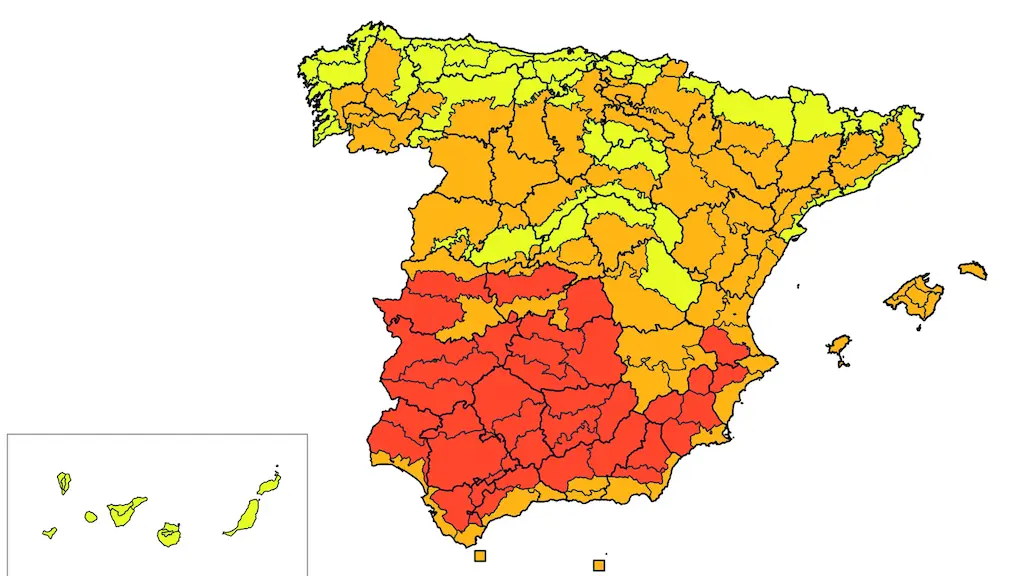
This Tuesday September 30th, Spain’s State Meteorological Agency Aemet has issued a red weather alert for heavy rain and storms in the Balearic Islands, as well as an orange warning for the Alicante province.
This is due to Storm Gabrielle, which swept across the Valencia region yesterday on Monday September 29th, bringing with it torrential rain and severe flooding.
So what exactly does Spain’s alert system mean and what do each of the colours stand for? How should you act depending on the warning, whether it's a heatwave, strong winds, heavy rain or snow?
READ ALSO: Spain's Valencia flooded after second night of torrential rain
Aemet defines an adverse meteorological phenomenon as any "any atmospheric event capable of causing, directly or indirectly, harm to people or considerable material damage".
When it comes to serious weather conditions, advanced warning is invaluable and can even be a matter of life and death in certain situations. This is why Aemet issue warnings ahead of time and colour code each one to show residents how mild or serious it is.
The National Plan for Prediction and Monitoring of Adverse Meteorological Phenomena is known as Meteoalert.
READ ALSO: Spain's Ibiza and Formentera on flood alert as Storm Gabrielle hits
It aims to provide the best and most up-to-date information possible on the adverse atmospheric phenomena that are expected up to 72 hours in advance.
It's purpose is also to maintain timely information on the evolution of weather fronts across Spain's 17 regions, 50 provinces and 326 comarcas (traditional territorial division).
AEMET sends these warnings to the affected regions' Civil Protection Units and it's up to them study the information and decide when and how to alerts its population.
When there's severely adverse weather, regional authorities may choose to send a loud SMS alert to everyone within the territory.
They have to act fast, and in the case of the Valencia floods, there are questions being asked about how timely and effective the warning system was.
READ ALSO: How Spain will warn you via SMS of nearby dangers
You can find out the latest alerts for your region on this AEMET map.
It shows which regions have coloured alerts in place and the reason, as well as information on rain probability, expected wind speeds and the times they are expected to start and end.
It's important to note that the thresholds for alerts are not the same for all of Spain, and they depend on different regions. Generally, the red warning for heat is issued at 40-44C, while the orange warning is issued at 37-40C, explains Rubén Del Campo, spokesperson for Aemet.
The different warning levels tend to be "more restrictive in the southern half of the peninsula, and more lenient in mountainous areas and the far north," although, in general, they are "very well established," Del Campo said.
MAPS: The places in Spain most at risk of recurring flash floods
What do each of the colours mean?
Green signifies that there is no meteorological risk. The weather is not expected to cause significant impacts, although there may be minor issues.
Yellow means that there is no meteorological risk for the general population, although there is for some specific weather fronts in the area. Aemet’s recommendation to pay attention and stay informed of the most up-to-date weather forecast. Some outdoor activities may be disrupted.
Orange alerts mean there is a significant meteorological risk. This includes unusual meteorological phenomena with a certain degree of danger for usual activities. Aemet recommends that you be prepared, take precautions and stay informed of the latest weather forecast. Regular and outdoor activities may be altered.
Red is the highest level of meteorological alert and it is for extreme risk - unusual meteorological phenomena of exceptional intensity. It also has a high level of risk for the population. The recommendation for this level is to take preventive measures and act according to the instructions of the authorities. You must also stay informed of the most up-to-date weather forecast. Normal activities may be severely disrupted, and you must not travel unless strictly necessary.
MeteoAlarm is another type of coloured alert system used across the EU. It also follows a similar alert pattern to AEMET with yellow, orange and red warnings.
This is useful if you intend to travel to another nearby country or if you need to travel frequently and need regular updates.
Comments