
In Spain, there’s a custom that burials and funerals are generally carried within 48 hours of the person dying.
In fact, they have to be 24 hours after death but no later than 48. Of course, in certain cases, deaths in unexplained or violent circumstances, for example, this period is extended.
According to Mapfre, one of Spain’s biggest insurers: “Once the death has been registered, the registrar issues the burial permit, which allows the body to be buried or cremated. Relatives can request this document, although as a general rule, the funeral parlour usually takes care of this."
READ ALSO: What are the options for affordable funeral services in Spain?
"From this point onwards, the funeral parlour is responsible for all the services related to the transfer of the deceased, the wake, etc. It should be borne in mind that the time between the death and the funeral cannot be less than 24 hours or more than 48 hours, except in special cases.”
These special cases depend on the situation and, crucially, whether or not the body is embalmed. In Spain, embalming as a practice is less common than in other countries. Often the body isn’t embalmed at all or is only partly embalmed.
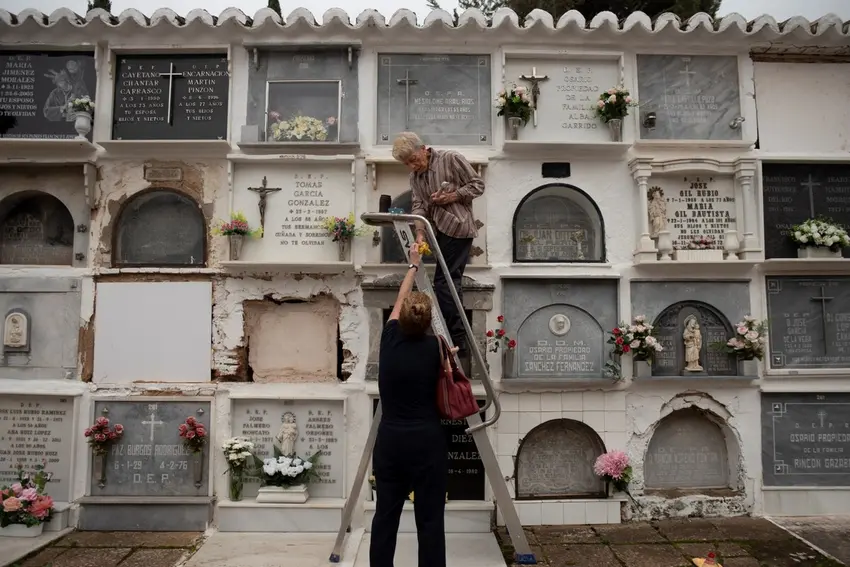
Usually, first it's the funeral and then the burial, which is either underground, as is common abroad, but often in a family plot in a wall.
Cremations have become far more common in Spain in recent years, tripling in frequency over the past 15 years and are now almost as common as burials.
Spanish legal experts Davies Abogados have some useful guidelines on processing times, depending on the case:
- Embalmed bodies must be buried within 96 hours.
- Bodies preserved temporarily must be buried within 72 hours.
- Unembalmed bodies must be buried within 48 hours, but not before 24 hours have passed.
- In case of contagious disease, immediate burial is necessary.
So, depending on the situation, most bodies in Spain must be buried within four days (96 hours).
Unembalmed bodies, more common in Spain, must be done within two days.
Regardless of the timeframe, this may well be quicker than burial and funeral conventions than you’re used to in your home country.
In France for example the maximum time that can pass from a person dying to them being buried or cremated is two weeks. In Norway, it's 10 days. In the UK and Sweden, a funeral can take place up to a month after the person passed away (until 2012 it was two months in Sweden!).
Where does Spain’s rapid burial culture come from?
There’s a couple of possible explanations. The first is that the tradition could come from the Spanish climate.
Josep Ventura, from the funeral company Áltima, told the Spanish press that the burial customs of northern countries, in which the cooler climate means they can wait days and even weeks to bury the dead, is a reflection of the evolution of society and the weather.
In the past, countries with lower temperatures were better able to preserve corpses when there was no machinery or tech to do so. Cemeteries were filled with ice and snow and had to wait weeks, even months, for spring to arrive and bury the bodies.
On the other hand, in warmer countries like Spain, burials had to be done quickly because of the speed at which bodies decomposed in the heat. Of course, modern day refrigeration systems allow bodies to be preserved for several days, but perhaps the culture has survived.
Some experts suggest there’s also a cultural or psychological element at play here too. Psychologist Begoña Elizalde, a specialist in grief and loss, revealed in an interview with 324.cat that Spain’s quick burial culture could be because Spaniards “are in a hurry to get rid of the dead”. In this sense, it’s certainly true that the Spanish custom of quickly burying the dead is very different to other cultures that have prolonged wakes, such as in Ireland, where the body can be displayed for days.
Not in Spain, however. This is because, Elizalde suggests, Spain is a hedonistic society that enjoys pleasures but avoids difficulties or uncomfortable situations: “Everything ugly we hide, and death is very ugly and we get rid of it very quickly. We also do it with diseases, old age, syndromes or mental disorders. We put it away in certain hospital wards, special buildings and we don't mix it with life,” she said.
Key vocabulary
Entierro - burial, funeral
Tanatorio - funeral parlour
Funeraria - funeral home, undertakers
Velatorio - wake
Embalsamar - to embalm
READ ALSO: What to do when a foreigner dies in Spain
Comments (1)