
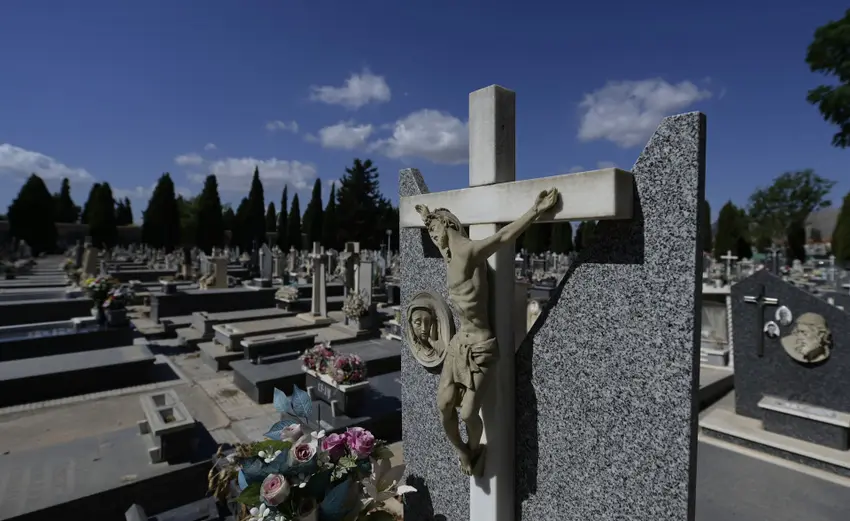
It's something nobody wants to think about but is one of the inevitabilities of life. A loved one dying can be an incredibly difficult time, but can also be an expensive experience too.
According to a study by Spain's biggest consumer watchdog, the Organización de Consumidores y Usuarios (OCU), in Spain in 2023 the average cost of a funeral service (with all the various expenses for the coffin, plot at the cemetery, undertakers, hearse, flowers, and so on) came out over €3,700.
And as with most things in Spain, there's some pretty significant regional variances here, and in some places such as Madrid, a funeral service can easily exceed €5,000.
READ ALSO: What to do when a foreigner dies in Spain
To read a more detailed breakdown of the different costs involved (as well as some regional comparisons) of organising a funeral in Spain, you can read our coverage of it here.
But if going for a full funeral service and burial is out of the question, you might consider other ways to keep costs down.
Cremation
Opting for cremation can help you save on funeral costs.
Cremations now account for 40 percent of services in Spain, a rise of over 20 percent over the last decade and something that will likely become more common as the country becomes more secular with time. Direct cremations (from coffin to cremation and straight into the urn) are the cheapest way. The cost depends on where in Spain you are and ranges from €840 in Almería to €330 in Cordoba or Seville.
For a full breakdown of the costs of cremation services in different parts of Spain (as well as full burials, for comparison) you can read the OCU report here. But in Madrid, to take an example, the cost of a cremation service (€931) is less than half that of a burial (€2,035).
It's worth noting that not all municipal cemeteries offer cremation services, so it's advised to check in your local area.
Donating the body for research
Donating the body of your loved one for scientific research is another option, and far cheaper than most alternatives. The university or hospital will pay for the cost of transferring the body to the research centre, so the cost is usually free for families.
However, technically speaking, everyone is already an organ donor due to its opt-out system. In Spain, unless you explicitly opt out, everyone is automatically an organ donor once they die. It's a system that's helped Spain become a world leader in organ donations, but that doesn't mean that you'll necessarily have your organs taken for donation after you die.
READ ALSO: Why everyone who dies in Spain is automatically an organ donor
Donating entire bodies for research purposes, on the other hand, the deceased must have stipulated and actively opted in to this before death. This is also only an option if the body is in good condition. Violent death, serious illness, amputations and certain types of surgeries therefore rule some people out as candidates altogether.
Mass grave
Far from ideal, but all local councils have protocols for the disposal of unclaimed bodies that haven't or can't be buried by the families. These usually involve a short-term burial and then exhumation and removal to a shared grave. For families who can't afford to bury their loved one, it could be an option because the council covers the costs.
They are known as 'charitable burials' and in 2013 in Barcelona, for example, they represented 2.5 percent of the total number of burials carried out in the city.
These burials are only available to poorer families who really have no way of affording a funeral service, and after the council establishes the family's financial situation. The thresholds vary from city to city. In Barcelona an income of less than €500 per month is the cutt off, while in Valladolid the income must be below €6,000 per year.
People are usually buried in shallow, unmarked graves for a period of five years. Once this period has expired, the remains are exhumed and end up in a mass grave. Each burial costs the municipality around €700, hence the financial background checks to make sure they are only offered to those in need.
It should be noted that all prices and expenses quoted in this article are averages based on OCU data without having death insurance, something that would significantly lower funeral costs.
Comments