

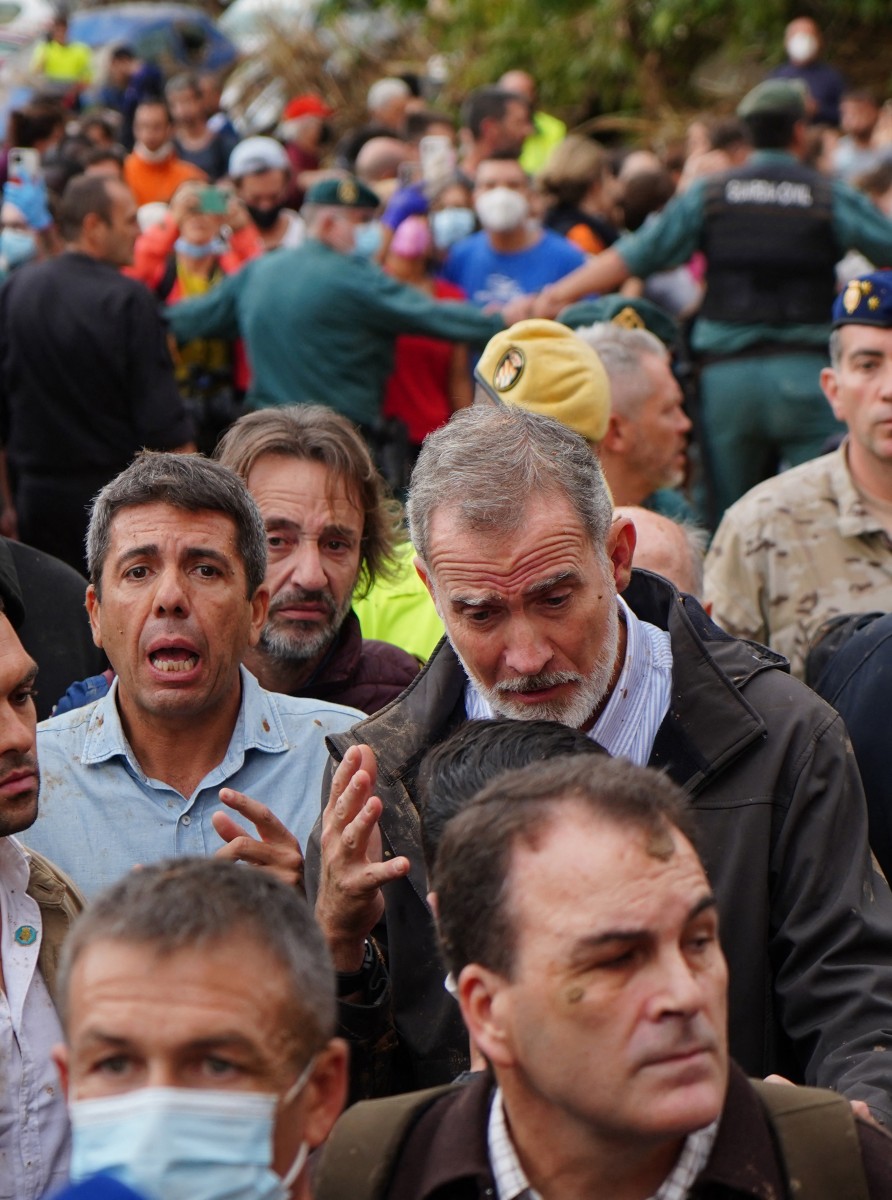
As a crowd of angry people encircled Spain King Felipe VI on Sunday in the Valencian town of Paiporta - the epicentre of the deadliest floods in modern Spanish history - a bewildered figure stood beside him.
Carlos Mazón, Valencia’s right-wing regional president, seemed all too happy that the towering 6 ft 5 royal was getting most of the attention from the frustrated mob, until they did notice him and he had to flee the scene.
READ MORE: Crowd hurls mud and insults at Spain's royals on flood zone visit
The Popular Party politician has become acutely aware that among most Valencianos, the Spanish press and of course his political opponents, he has been singled out as the main culprit of the lack of preparation and quick action required for a disaster of this magnitude.
This has not been reflected in English-language coverage of the floods, however.
In reality, going solely off the facts it seems Mazón has a lot to answer for.
Bullfights over emergency response
“You’re going to be a historic figure,” Compromís deputy and climate expert Juan Bordera warned Mazón in 2023, soon after the PP leader voted against his proposal to introduce measures that would prevent the risk of floods along the Mediterranean coast.
“You’ll be the one who allowed the denialist circus in the Valencian Council.”
Bordera was referring to the fact that Mazón had handed over the management of Valencia’s Emergencies Unit (UME) to far-right party Vox, a party he’d been willing to partner up with to reach power in the eastern region.
Vox is openly a climate change denier party (including Valencia's Head of Justice Elisa Núñez), and it wasn’t long after reaching power that Mazón closed Valencia’s Emergency Unit altogether, the main body tasked with natural disasters in the region of 5 million.
Instead, Mazón ended up giving €17 million in public funds to the bullfighting ‘industry’.
The 50-year-old leader from Alicante was also in the process of removing environmental taxes and scrapping the Valencian Climate Change department.
“If you get rid of the departments that have to be on the frontline and those that can promote preventative policies, you end up reaping what you sow,” politician and former Greenpeace head Juantxo López Uralde has said of Mazón policies.
READ ALSO: 10 things you need to know about Spain's Vox far-right party
Crisis management
But it's not just Mazón's previous decision making that worsened the disaster in Valencia. Poor crisis management also played a role.
La Sexta reports that Mazón arrived two hours late to the DANA emergency meeting on the day of the tragedy. Spain’s weather agency Aemet sent out 7 warnings about the DANA in Valencia which Mazón ignored.
Aemet had declared a red level alert, the highest level, first thing on Tuesday morning. Yet Mazón did nothing, and sent no warnings to the citizens of Valencia, who went about their days as normal. In fact, he later deleted a tweet in which he said that the rain would end at 6pm.
Crucially, the SMS alert system was sent out too late, hours after the flooding had begun and videos of the rising water were already circulating on Spanish social media networks. Many of the dead were caught in the floods on their way home from work.
READ ALSO: What do Spain's orange and red weather alerts mean for the public?
However, Valencian council workers were told to leave work early, so clearly the authorities had some idea of the severity of the situation.
Reporting by El Diario confirms that Valencia Council workers were sent an email at 2pm, recommending that all workplaces close "to avoid risks to workers."
Valencian citizens, however, didn't receive the SMS alert until 8.12pm.
On top of that, Mazón's government did not bring in the emergency response team fast enough.
Javier Marcos, the general in charge of the Emergency Military Unit (UME) has directly denied Mazón's claims that he requested emergency assistance. Marcos had mobilised his soldiers, but the decision to enter the affected areas was not his. "I can have 1,000 soldiers at the door, but I cannot legally enter until the emergency director authorises me," Marcos explained.
"As soon as the Generalitat gave us the green light, we were in the emergency zone within minutes," he added.
Mazón also reportedly rejected help from firefighters from Catalonia, Navarre and Bilbao.
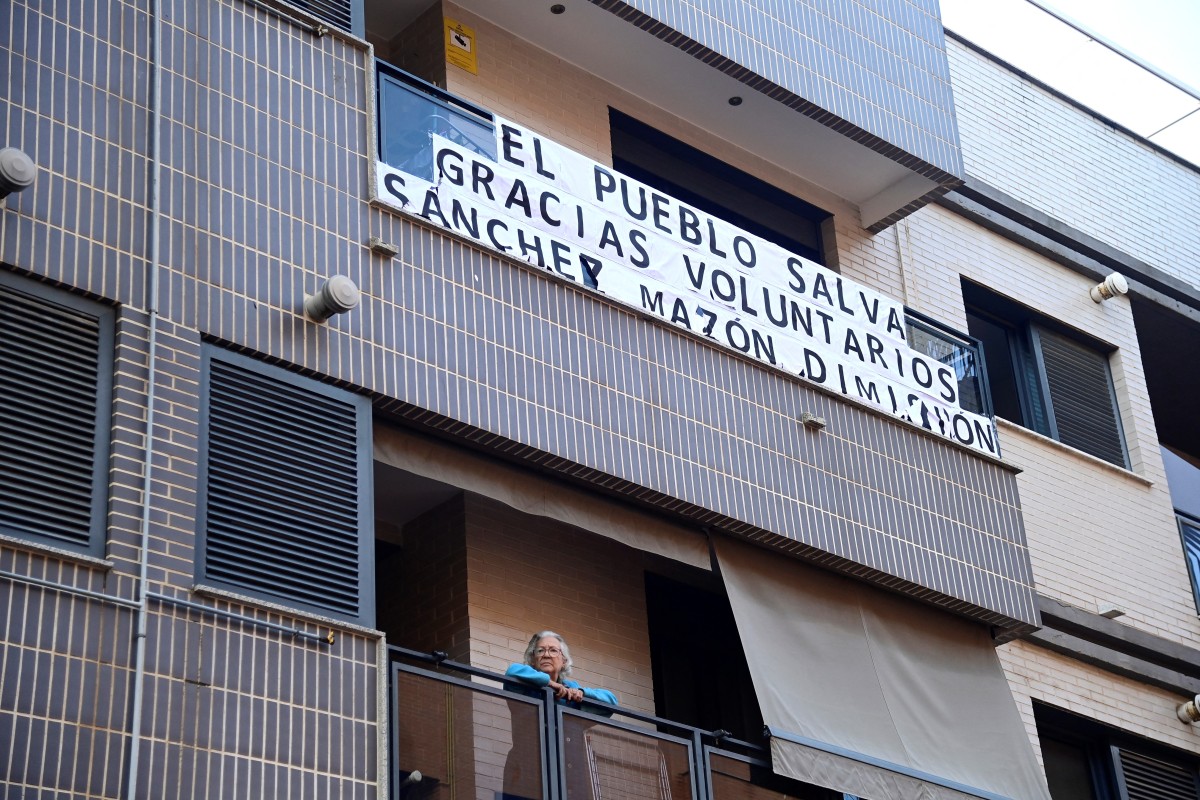 A woman stands on a balcony next to a banner reading "The people save (the people), thanks volunteers, Sánchez and Mazón must resign". (Photo by JOSE JORDAN / AFP)
Passing the buck
Since the flooding, Mazón has tried to shift responsibility onto the national government. Much of the political blame game has rested on the structure of Spain's regional system and debate over who, ultimately, responsibility rests with.
Mazón has attempted to blame Spain's Hydrological Confederation, a central government body, claiming that "No doubt we would have sent the alarm message earlier if we had had the reactivation of the hydrological alert by the confederation. It would have been done immediately."
However, the Ministry of Ecological Transition has rejected this, stating that confederations don't control alerts: "The competent body for launching hydrological alerts are the regional emergency services," it said.
In Spain power is decentralised in a system of autonomous communities or regions. This devolved system, whether it be on taxation or emergency response, largely puts the levers of power in the hands of regional governments. In Valencia, this is La Generalitat, of which Mazón is the President.
Spain’s state weather agency is tasked with sending weather warnings to affected regions, who then have to decide to alert town halls across their territories. Town halls then put in place emergency plans, such as closing schools, parks, and evacuating flood-prone areas.
But when disaster strikes, it’s the regional authority that takes control when town halls can no longer manage on their own.
Spain’s central government can step in when asked to by the region, to request more national police and army officers, for example, but the region remains in control unless it requests that Madrid take the reins.
READ ALSO: Anger at government grows in ground zero of Spain floods
In order for Madrid to take control, the regional government must raise the crisis level. Mazón was reluctant to do this, and this is where politics could have been a stumbling block.
The most plausible part of Mazón's defence is the lack of action and collaboration between Valencian and national authorities. The Valencia region is run by the right-wing Partido Popular, whereas the national government is Sánchez's Socialist (PSOE) led-coalition.
The two parties have been at logger-heads for well over a year and Sánchez's right-wing critics have increasingly accused him of behaving in a 'dictatorial' way.
It seems believable that the central government could (before the full extent of the damage was clear) have thought twice about taking control of the situation if it might've been perceived as an overreach, or play into narratives critical of it.
Similarly, it seems unlikely a PP-run region would want to be seen giving up power to the Sánchez government.
Nonetheless, this couldn't have legally been done until Mazón formally requested help, something he did not do. But the idea of distrust or hesitation on the part of both or either the regional or national governments seems plausible.
READ ALSO: Why did flood victims get so angry with Spain's royals?
Comments (2)