
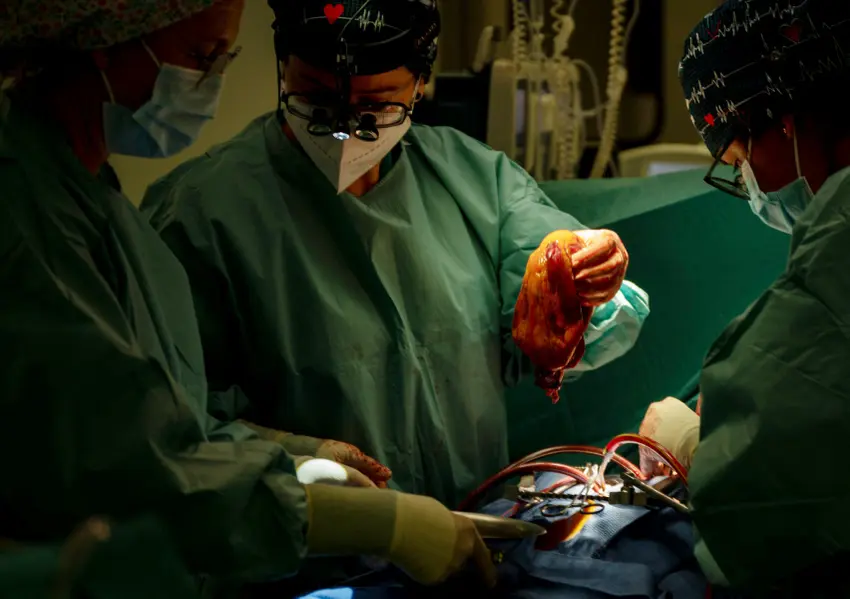
In many countries around the world, signing up to be an organ donor is something of a point of pride -- a way to help others (or science) once you're gone.
But in Spain, unless you explicitly opt out (more on that below) everyone is automatically an organ donor once they die. It's a system that's helped Spain become a world leader in organ donations, but that doesn't mean that you'll necessarily have your organs taken for donation after you die.
In Spain, the law on organ donation is clear, as outlined in Royal Decree 1723/2012. According to the Article 9 of the law:
Requirements for the procurement of organs from a deceased donor:
1. The procurement of organs from deceased donors for therapeutic purposes may be carried out if the following requirements are met:
a) That the deceased person from whom organs are to be procured has not left an express record of his or her opposition to organ procurement being carried out after his or her death. This opposition, as well as their agreement if they wish to express it, may refer to all types of organs or only to some of them and shall be respected.
In the case of minors or disabled people, the opposition may be recorded by those who, during their lifetime, were their legal representatives, in accordance with the provisions of civil legislation.
This means that you'll automatically be considered an organ donor and your organs (some or all) could be used for donation after your death. You are allowed, if you wish, to specify that only certain organs can or can't be used.
Legally speaking this custom is known as 'presumed consent' and it basically means that everyone in Spain everyone is an organ donor by default, and the only way to bypass or cancel that presumed consent is to express your opposition to being an organ donor, usually in writing.
READ ALSO: How Spain became the world leader in organ transplants
This system seems to work well for Spain, because according to La Moncloa, Spain has been a world leader in organ donations for three decades, with a rate of 38 donors per million people. Spaniards make a disproportionate number of donations at the EU level. In 2020 Spain contributed 19 percent of total EU organ donations and 5 percent of those registered internationally, despite the fact that Spain represents less than 10 percent of the EU's population and just 0.6 percent of the global population.
But this doesn't mean that every dead person in Spain is immediately stripped of their organs when they die. There's a thorough list of requirements that must be met in order for organs to be accepted for donation, meaning that only a very small fraction of deaths actually result in donation in Spain.
That the deceased had no diseases (cancer or serious infections that are difficult to treat, for example) that could pose a risk to the possible organ recipient is a major one.
An interview with the family or medical professional is also carried out, in order to check if the deceased had opted out of donation and to formally request that the process begin.
In cases of death due to non-natural causes (traffic accidents, suicides, murder, and so on) a judicial authorisation is required for donations, and it must not interfere with any criminal or judicial proceedings.
Comments