
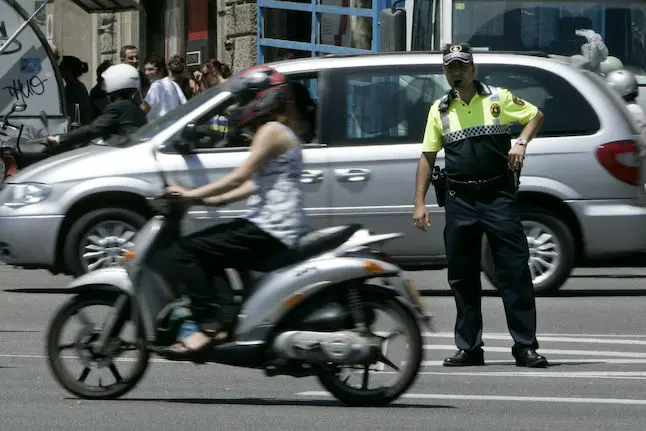
According to a report carried out by Estamos Seguros and the National Association of Companies in the Two-Wheel Sector (ANESDOR), one in every 10 vehicles in Spain is a scooter or motorcycle.
86.3 percent of those seriously injured in traffic accidents are motorcyclists, according to the latest DGT data on road accidents during the first half of 2022.
DGT head Pere Navarro recently signed an agreement with Barcelona City Council, promising to try and solve the high accident rate of motorbikes in the Catalan capital and tackle road safety. One of the possible solutions he suggested was to create motorcycle-only traffic lanes.
Navarro confirmed that one of the most popular vehicles in Spain doesn’t have its own dedicated space. "We need to reflect and think about a possible redistribution of space to adapt to the new circumstances", he said.
In Barcelona, there have already been six deaths from motorcycle accidents this year and it is one of the cities in the world with the greatest number of motorbikes. They make up around 33 percent of the vehicles on the road in the city.
Some cities in the world, including some in Latin America, already have traffic lanes reserved exclusively for two-wheeled vehicles.
The latest EuroRAP confirmed that motorcycle drivers were still the most vulnerable on the road and 45 percent of traffic accidents with serious or fatal injuries in Catalonia usually involve this type of vehicle.
However, Barcelona Town Hall believes that motorbikes are still a great mode of transport in cities as they have many advantages.
They take up very little space when parked, they have lower fuel consumption and they offer flexibility.
READ ALSO: How to get a motorbike or moped licence in Spain
The agreement between Barcelona City Council and the DGT promised to collect precise information to help lower the number of accidents and carry out studies and surveys. It will also look at the uses of motorbikes in the city such as ridesharing, commuters, tourists and delivery drivers.
Experts will analyse all the data to determine the best move forward and to see if motorcycle-only lanes should be introduced or not, as well as other methods of preventing accidents. Initiatives and pilot projects will also be carried out such as training, practical demonstrations and campaigns.
The other part of the agreement includes the introduction of technological innovations, both on the road and in the vehicle itself. One of these is the use of the airbag vest for motorcycle drivers, which the DGT considers essential.
Navarro announced that motorised traffic units will start using these vests across Spain in 2023.
Finally, the studies will identify places with the highest accident rates, improve crossings and increase the visibility of motorcycles, as well as improve upon the separators between roads and bike lanes. This is where the point about exclusive lanes for motorcycles will come in.
Vigo was the first city in Spain to create motorcycle-only lanes in 2015 and today is one of the cities with the greatest number of them.
In 2021, in Madrid, there was also a pilot project to make an exclusive motorcycle-only lane on Avenida de Asturias.
Many other cities in Spain allow motorcycle drivers to use the bus and taxi lanes, but they do not have their own exclusive lanes like the DGT is suggesting.
If the project goes ahead in Barcelona, however, and is successful it could mean that the idea is rolled out across the country and you may see motorbike-only lanes near you.
Comments