
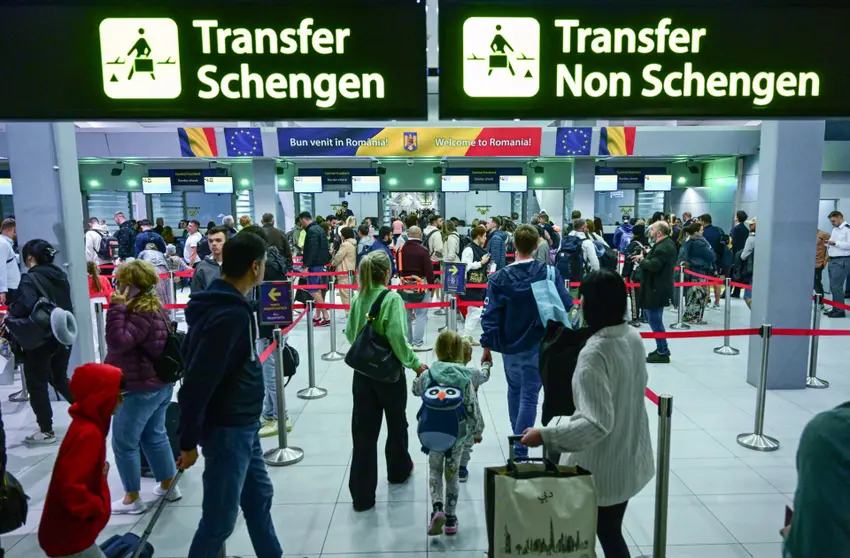
Italy’s decision to reintroduce border checks with Spain – and Madrid reciprocating with Rome – after the arrival of thousands of people in the Spanish exclave of Ceuta, has reignited the debate about the functioning of the Schengen area, a free-travel zone including 29 European countries.
Media and commentators have warned that the regular reintroduction of border controls between European countries puts in question the EU principle of free movement of people. But what is the relation between Schengen and EU free movement rules?
What is the Schengen Agreement
The Schengen Agreement was signed in 1985 by France, West Germany, Belgium, the Netherlands and Luxembourg to abolish internal border checks. It was followed in 1990 by the Schengen Convention, signed by more countries, which became effective in 1995.
The Treaty of Amsterdam, in 1997, incorporated Schengen into the legal system of the European Union.
Today, the Schengen area includes 25 of the 27 EU member states (Cyprus and Ireland are not part of it), and the four countries of the European Free Trade Association (Iceland, Liechtenstein, Norway and Switzerland). Some 3.5 million people cross internal borders every day, including cross-border commuters, and 32 million enterprises benefit from faster transport and reduced costs, the European Commission notes.
Romania and Bulgaria were the latest to join, on January 1st 2025, and Cyprus is expected to become part of the free travel area in the near future too.
Ireland is not a signatory of the Schengen Convention because this would undermine the Common Travel Area arrangements with the UK and require establishing a hard border with Northern Ireland.
The Schengen Convention not only abolished internal border checks, but also established a common visa for short term non-EU visitors, and sought to strengthen controls at the external borders.
In this regard, in October 2025, Schengen countries introduced the Entry/Exit System (EES), an IT infrastructure that records short-term non-EU visitors each time they enter and exit the Schengen territory.
Schengen rules allow countries to temporarily restore internal border controls if there is a “serious threat to public policy or internal security”, but these should be limited to the period “strictly necessary” to respond to the threat.
What is EU free movement of people
Free movement of people is one of the “four freedoms” of the European single market, which guarantee that goods, services, people and capital can move across countries unchecked. Free movement rules apply across EU countries, as well as Iceland, Liechtenstein, Norway and Switzerland.
Free movement of people was first mentioned in the Treaty of Rome of 1957, which established the European Economic Community. At that time, it concerned mainly workers and service providers. The Treaty of Maastricht of 1992 established EU citizenship, which guarantees the right for EU citizens to move to live, work or study in other EU member states.
The free movement directive of 1994 combined previous measures and set out the conditions under which EU citizens and their family members can exercise free movement rights in the EU, as well as the right to non-discrimination based on nationality.
“The directive is designed to encourage EU citizens to exercise their right to move and reside freely within the Member States, to cut back administrative formalities to the bare essentials, and to limit the scope for refusing entry or terminating the right of residence,” says a European Parliament explainer.
EU social security coordination regulations also set the conditions to combine state pension contributions across EU countries, access social benefits and receive healthcare – including when travelling, with the European Health Insurance Card (EHIC).
Over the years, the Court of Justice of the EU has intervened in many of these areas with judgments seeking to remove obstacles to the possibility of EU citizens to exercise their free movement rights. Some of the most recent ones concerned, for instance, free movement rights for same-sex spouses.
Free movement therefore comprises a complex body of legislation covering many elements of moving and living across borders. Schengen is a very important and tangible one.
Comments (1)