
Thousands of Ceuta residents protest against migrant crisis
The four religious communities of Ceuta (Christian, Muslim, Jewish, and Hindu) on Sunday held a demonstration to demand solutions to the migration crisis affecting the autonomous city.
According to the organisers, more than 10,000 people attended the rally, a figure lowered by the National Police, who put the number of demonstrators at 5,000.
READ ALSO: Migrant children sleeping rough in Spain's Ceuta at risk of abuse
Protesters are called for greater involvement from the central government in the migration crisis; reinforcement of the National Police and the Civil Guard; increased control and protection of the border with Morocco; and measures for migrants remaining in Ceuta, as well as relief from the pressure on reception centres.
Over the weekend, Ceuta's leader said there were still between 8,000 and 11,000 migrants left in Ceuta after the mass crossing of July 30th, a figure far higher than then 2,000 that Spain's Interior Ministry had suggested earlier.
Italy slams Spain for also imposing Schengen border controls
Italian Foreign Minister Antonio Tajani on Sunday said Spain's decision to also suspend the Schengen free movement agreement in response to the very same initiative by Rome was "incomprehensible and totally unacceptable."
Meloni's government established border controls after the mass arrival of migrants from Morocco in Ceuta on July 30th, even though the Spanish enclave is not part of Schengen.
READ ALSO: Spain imposes border checks on Italy as migrant showdown grows
The Spanish government hopes the move will make Italy "react" and "clearly" understand that the Schengen area is guaranteed, having not been affected by any immigrant arriving from Ceuta.
In an interview published this Sunday in the Italian newspaper La Stampa, Antonio Tajani stated that "we suspended the Schengen Area, as required by the Treaties, because something extraordinary happened" in Ceuta.
"We hope to be able to lift the suspension soon, as soon as the risk has disappeared. It is Sánchez who has dramatized the situation," the minister, who is also the leader of the Forza Italia political party, declared.
Spain has almost 8 million non-primary residences
A report by Spain's Ministry of Housing has found that 28.6 percent of homes in Spain are not primary residences, a total of 7.7 million homes that could cover ten times the residential deficit, compared to the country's 27 million primary residences.
The Bank of Spain recently highlighted a few weeks ago that the housing deficit in Spain is 750,000 units.
A primary residence (or habitual residence) is the property where a person or family effectively resides for all or most of the year.
Only four European countries have more empty homes and second residences than Spain.
Flamingo chicks ringed at Spain's main breeding site
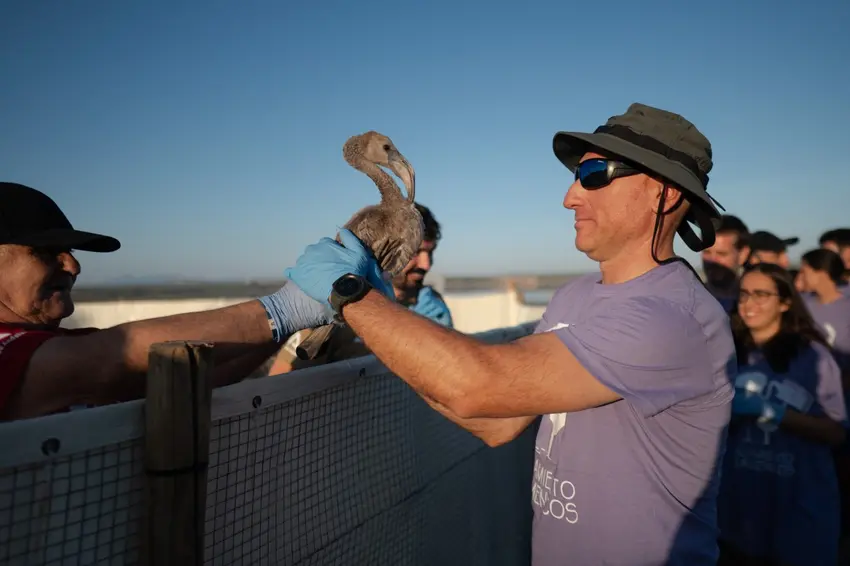
Around 600 greater flamingo chicks were ringed on Saturday at the Fuente de Piedra Lagoon Natural Reserve in Málaga, southern Spain, out of the 15,500 chicks born this year, the third-highest figure ever registered at the wetland.
The high birth rate this year is largely down to the high amount of rain recorded at the start of this year.
The Fuente de Piedra lagoon, the Iberian Peninsula's main flamingo breeding site, is a nature reserve home to more than 170 recorded bird species.
Flamingo chicks are ringed to help scientists and conservationists track individual birds, study migration patterns across continents, as well as monitor population health, survival rates, and reproductive success over time.
More than 400 people participated in the operation coordinated by the Andalusian government, which was carried out in the early hours of Saturday morning and completed in just four hours.
Comments