
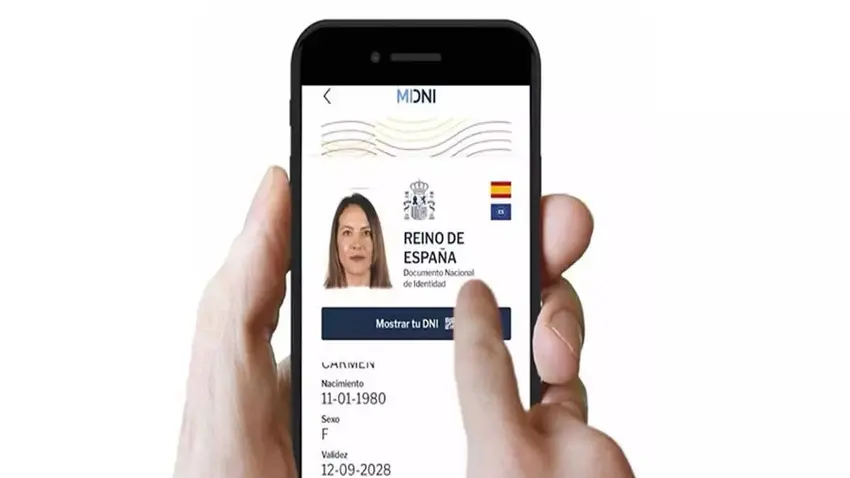
If you have Spanish nationality, you will have been issued what’s known as a DNI, which stands for Documento Nacional de Identidad (National Identity Document).
After being approved by the Spanish Cabinet in 2025, Spanish National Police launched a new digital version of the card via the app - MiDNI.
Crucially, on April 2nd 2026 it became legally acceptable for Spanish citizens to identify themselves via these digital IDs on their mobile phones.
From this point forward, public and private entities will be required to accept these digital IDs in digital format.
Currently this digital ID is only available for the DNI cards of Spanish nationals, not the TIE cards for non-EU foreign residents or the green residency cards for EU residents in Spain.
What is Spain's new digital DNI used for?
According to the National Police, this document does "everything that a physical ID can do, except for the functions provided by electronic certificates".
This will allow for identity verification in numerous situations, such as procedures in a government office, hotel check-in, vehicle rentals, package collection, and medication pickup at pharmacies, among others.
Not only can it be used to provide identification, but also to establish any type of legal relationship, to identify oneself before a notary for signing deeds to a property or other admin procedures such as confirming your age.
At the moment you cannot use it for online authentication and/or electronic signature procedures like you can with the digital certificate and cl@ve pin.
You also cannot use it to travel outside of Spain either, like you can with the physical DNI card within the EU.
READ ALSO: How to get Spain's digital certificate without an in-person appointment
How do I apply for Spain's digital DNI?
To use the digital ID card, you must first have a valid physical DNI card and a digital certificate (here's how to get it if you don't have one).
This is essential for the initial registration, which involves linking a citizen's identity to a mobile phone number.
A Spanish national identity card (DNI) can only be associated with one mobile phone number.
The next step can be done online at www.midni.gob.es, or at National Police stations, or at town halls that have Documentation Update Points (Puntos de actualización de documentación).
After this, the user must download the MiDNI application on their phone, enter their DNI and support numbers, create a password and confirm the process using a code received via SMS.
How does MiDNI work?
After registering and downloading your app, you can use the digital DNI in different ways. The app will provide DNI options with three levels of information depending on what you need it for.
The first will be used to prove your age and will show only your photo and date of birth (DNI Edad).
The second will open a simple document format with your name, surname, gender, date of birth, DNI validity and photo (DNI Simple).
The third option will present all your document information (DNI Completo), the same as the physical DNI.
Therefore, users will initially not see an image of their ID card on their mobile screen, but rather a QR code where they can choose which data to display depending on their intended use.
This code, generated by Spain's National Police, ensures the data's authenticity and will remain visible for 60 seconds.
After this period, it will expire, and a new code will need to be generated. The QR code can be scanned by any other device on which the MiDNI application has been installed.
If you change your mobile phone , you will have to register and download the application again with the new device. In case of loss or theft of the document, the digital version can be cancelled by filing a police report.
Spanish National Police have reminded the public that the digital DNI is "complementary" to the physical document and in no case replaces the traditional one, which must be renewed once it expires and reported in case of loss or theft.
Comments