
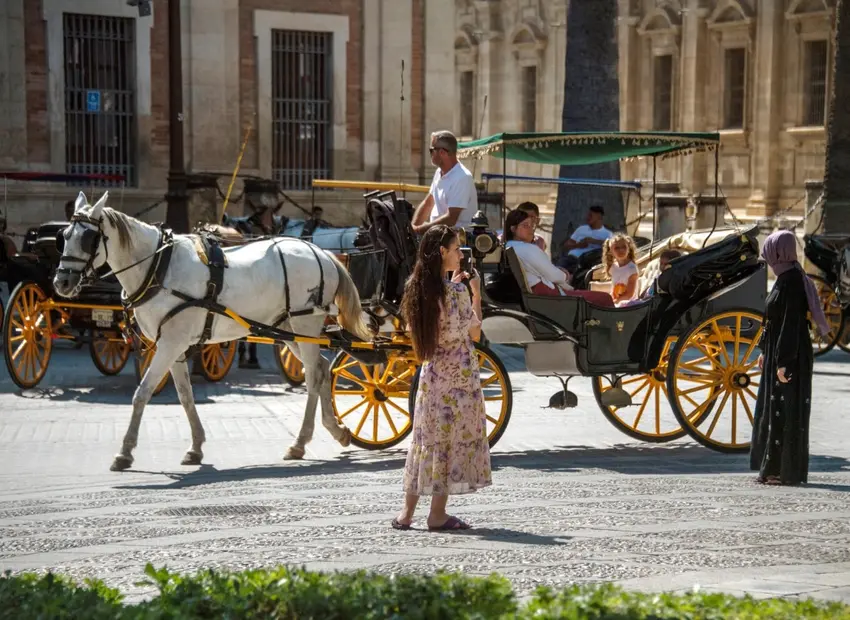
There are a few cities and towns across Spain, especially in Andalusia, where horse-drawn carriages are still a thing, even though they’re mainly a tourist attraction nowadays.
Spain is unfortunately still a country where for the most part animal rights are conspicuous by their absence, but there’s been increasing awareness in recent years about the harsh conditions these stallions endure.
Cruelty from their owners, long working hours, exposure to life-threatening heat - there are certainly caballos (horses) in Spain that have it better.
So it’s perhaps no surprise that Málaga’s mayor recently announced that he wants 2025 to be the last year in which horse-drawn carriages ferry holidaymakers around town.
"We are taking this step thinking about the welfare of the animals and the image that Málaga offers to the world,” Málaga mayor Francisco de la Torre said.
“In 2025 there will be much more efficient and respectful ways of getting around," adding that an e-bike scheme will probably be the best replacement.
As could be expected, the carriage owners and drivers are feeling fairly disgruntled, as not only has it been a lifelong job for them in most cases, their licences were still valid for another 11 years.
Still, there is talk of them being generously compensated, as much as €120,000 each.
Which city could be next? Córdoba? Granada? Seville? Or perhaps the donkey taxis of Mijas? Barcelona already banned horse-drawn carriages in 2015 and Palma de Mallorca promised to do so in 2024.
Málaga’s decision certainly appears to be a step in the right direction and one that could spur others to follow suit.
But what about the truly ingrained Spanish traditions that a bigger proportion of the Spanish population will be reluctant to let go of?
Bullfighting is the obvious one, but there are thousands of bull runs and other bull-themed festivals across Spain where animal suffering is ever-present (17,000 according to animal rights group PACMA).
It’s perhaps the aspect that foreigners most struggle to understand about Spain.
How can a country with such welcoming and warm people still tolerate barbaric traditions that tarnish their country’s image (not all Spaniards are in favour of it, mind you)?
Or if the ratio of pets to children under 4 is 6 to 1, why does Spain have the highest rate of animal abandonment in Europe during the summer?
READ ALSO: Will bullfighting ever be banned in Spain?
In other news, we’re just over three months away from the official end of Spain’s golden visa scheme (April 3rd), which means that non-EU nationals looking to gain Spanish residency by purchasing a property in Spain worth at least €500,000 have to rush.
And that’s exactly what they’ve been doing since Pedro Sánchez announced last April that his government would scrap the residency scheme for wealthy foreigners.
The latest government data indicate that between January and November 2024, 314 residence permits were granted in Catalonia alone, of which 98 percent (308 visas) were concentrated exclusively in the province of Barcelona.
Between January and October 2024, the number of golden visas granted across the whole of Spain totalled 780, which gives us an idea of just how popular Barcelona is as a golden visa ‘destination’.
In fact, Catalonia has been the preferred relocation spot for these rich this-country nationals for some time, attracting 60 percent of golden visa investments in Spain since 2020, with a total of 1,248 applications.
Chinese nationals (more than half of the total), followed by Iranians, Americans and Brits were those buying the most luxury homes in the Catalan capital to get the exclusive visa last year.
And how much did they pay on average to purchase a Barcelona property? €662,000, substantially above the €500,000 threshold.
Comments