
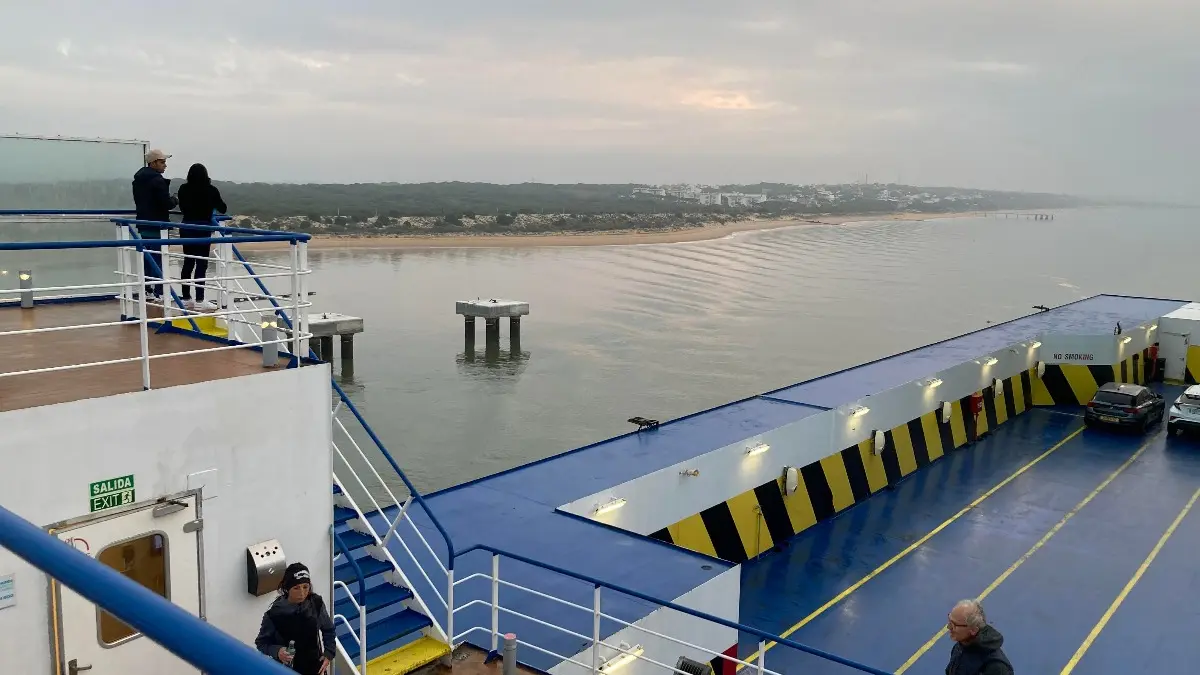
I’m writing this on board Balearia’s Marie Curie LNG-powered ferry, which is taking me from Santa Cruz de Tenerife to the Andalusian city of Huelva (three trips a week in partnership with another ferry company - Fred Olsen).
This is one of two options available to those who want to transport their vehicles between the Atlantic archipelago (Tenerife and Gran Canaria) and the Iberian Peninsula. The other is a service called Ro-Ro whereby it’s only your car that travels, and you pick it up on the other side, for roughly the same price.
That saves you a lot of travel time, as a flight to Seville (the closest airport to Huelva) takes under three hours, whilst the ferry takes around 35 hours.
Another reason to choose the boat over a plane is if you’re scared of flying, of course. If that is the case, the only alternative to reaching the Canaries from mainland Europe is catching this long ferry trip.
The ferry is also a very useful option for pet owners travelling between the Canary Islands and mainland Spain, either because you don’t want your cat or dog to travel in the plane cabin with you, or because your furry friend is too big to fit under the plane seat and you don’t like the idea of them going in the cargo.

What’s great about opting for this ferry as a dog owner is that your pooch can stay with you in the cabin, and there is a specific deck where you can take them out for a walk.
Pet owner or not, Balearia’s cabins are surprisingly good. They’re well-equipped with two comfortable separate beds and cushioned walls next to them that make them serve as sofas to sit up against, and this feature also makes it more comfortable when sleeping as there is a fair amount of motion on the ferry.
They’re tastefully decorated, they include a desk and chair, two complimentary bottles of water, a space to put your hand luggage, a couple of hangers for your clothes, TV with entertainment, a bedside table, several lights, three plugs for your electronics and a thermostat to control your room temperature.

There is also a bathroom with a shower and a washbasin with hot water, shower gel and towels.
Fortunately, there’s decent internet on board for free which reaches the cabins and everywhere else on the ferry, but you can only connect on one device. If you want a faster connection, you have to pay an extra €5 or €10, a small price to pay for such a long trip.
The cabin ticket also includes three three-course meals a day - breakfast, lunch and dinner (drinks not included) - all of which are much tastier and ample than airplane food (just remember about the motion sickness).
As a resident of the Canary Islands, I got a considerable discount on the ticket price, paying around €320 for my cabin and to bring my car with me (residents of the Balearics and the Canaries get up to 70 percent discount on flights and ferries to mainland Spain due to their ‘extra-peripheral’ location). If you want to check out prices, here's the website.
Therefore, the ticket can be considerably more expensive for non-residents - around €650 one way (depends on the specifics as well) - which explains why people in this situation often opt to sleep on one of the many comfortable seats (but still a seat, not a bed) in several lounges around the ferry instead of getting a cabin.

So are there any other downsides? The almost constant rocking of the boat is certainly a big drawback for anyone who tends to suffer from motion sickness. Even if you don’t, or you don’t know if you do, it’s advisable to come prepared with an ample serving of biodramina (tablets for dizziness), which should be taken with every meal.
You may still get a bit fed up with the constant motion of the ferry, and whether you find it easier to endure lying down or up on deck with the fresh air will depend on how you feel.
This is of course an awfully long trip, so come prepared with entertainment, and even if there are films and live TV to watch from your room (or on the numerous screens around the boat if you don’t book a cabin) be prepared to be a bit bored.
And if the price for a cabin is too expensive for you (as a resident or non-resident of Spain’s islands) sitting for 30+ hours in a seat is certainly challenging, especially when it comes to sleeping.
You’ll no doubt find an interesting assortment of fellow international passengers travelling alongside you, from people moving home, to globetrotters, bikers and devoted dog owners.
Depending on your circumstances, this may be the only realistic non-flight travel option available to you if you're travelling to or from Las Islas Canarias. It’s not cheap, nor easy, but it could be a lot worse.
¡Buen viaje! (Safe travels!)
Comments (1)