
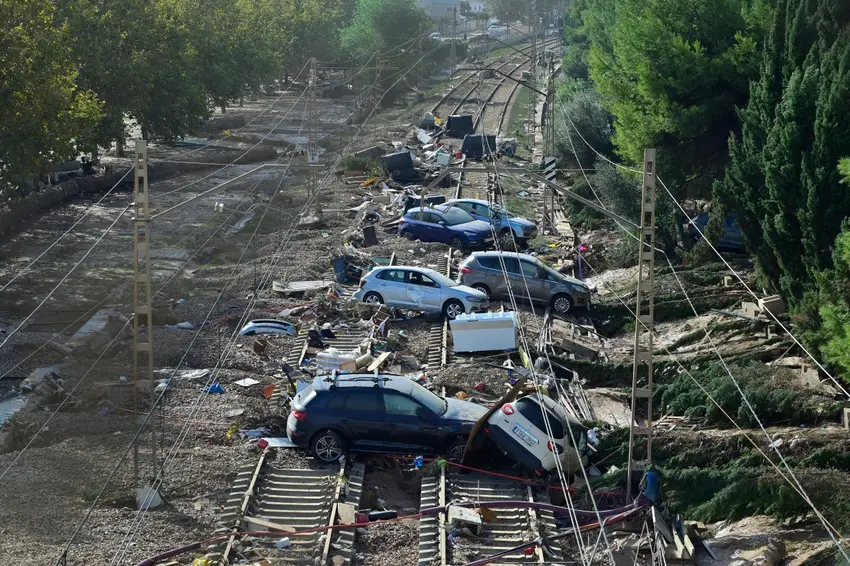
As Valencia begins to clear up the gargantuan amount of debris and damage caused by its worst floods in living memory, one of the most glaring problems authorities face is quickly re-establishing the province’s transport network.
WATCH: The most shocking videos of Valencia's devastating flash floods
The eastern region isn't the only part of Spain that's suffered the devastating effects of the DANA weather phenomenon, as Andalusia, Murcia, Castilla-La Mancha and other autonomous communities have also been flooded and had their transport networks impacted too.
Here we offer you a breakdown of the information available on how the flash floods are affecting and will affect air, rail and road travel in Spain.
Flights
There were plenty of flight cancellations, diversions and delays at Valencia’s Manises Airport on Wednesday as a result of the flooding, with footage showing the runway underwater and hundreds of passengers trapped inside the terminal.
On Thursday, the airport is largely back to its normal operational capacity, with no new reports of cancelled flights.
However, getting to Valencia’s airport or leaving it is what may prove particularly challenging because of the state of the province’s roads and rail network, which in turn makes flying to or from the city much more complicated.
Málaga airport also had to cancel and divert dozens of flights as a result of the torrential rain but is back to working order now.
Road travel
Moving around Valencia province by car is “not just not possible, at this moment it is totally inadvisable", Spain’s Transport Minister Oscar Puente has said.
Spain’s DGT traffic authorities have discouraged car usage in Valencia given the huge amounts of debris, wrecked cars and floodwater found all around the territory. Not to mention that numerous bridges have collapsed and hundreds of roads are not fit for driving.
The DGT has also asked that no-one from any other region in Spain drive to Valencia.
The A7 motorway, known as the Autovía del Mediterraneo as it goes all the way from Gibraltar to Barcelona, is cut off in several areas. This is by far the most driven highway to reach Valencia from Málaga, Alicante or the Costa Brava.
The A3 highway which connects Madrid with Valencia is also blocked in several parts.
Furthermore, even those not planning to drive to Valencia but who are using motorways and secondary roads that pass through the province could face difficulties.
Some 70 secondary roads (as well as the N-330 and N-331) are also unusable currently, as are Valencia’s V-30 and V-31 ring roads.
Therefore driving in, to or from Valencia is very, very difficult at present. Road travel will take at least “a few weeks” to return to normal, according to Puente.
In Andalusia, there are currently 23 important roads and highways affected by the floods, 13 in Cádiz, 7 in Seville and 3 in Granada.
In Málaga, the A-367, the A-7054 and the A-357 are facing difficulties.
These problems in the southern region coincide with the All Saints' Day long weekend, a period in which many people travel within Spain, leading Andalusian authorities to discourage travel by road. Crucially, more rain is forecast for the weekend.
However, there has been no suggestion made yet that motorways will be cut off for weeks as in the case of Valencia.
Train travel
There will be no trains between Madrid and Valencia for at least three weeks, Spain’s Transport Ministry has said.
In fact, all high-speed and medium-distance lines to Valencia have been suspended for at least several weeks.
But it’s the commuter rail network (Cercanías) used by thousands of Valencians to go to work or study every day that has borne the brunt of the flood damage.
The infrastructure has been left in such a devastating state of disrepair by the floods that it will likely take months to be fully operational again.
In Andalusia, trains between Seville and Málaga are currently cancelled due to the flooding but there is no indication yet of how affected the region's rail network is.
Comments