
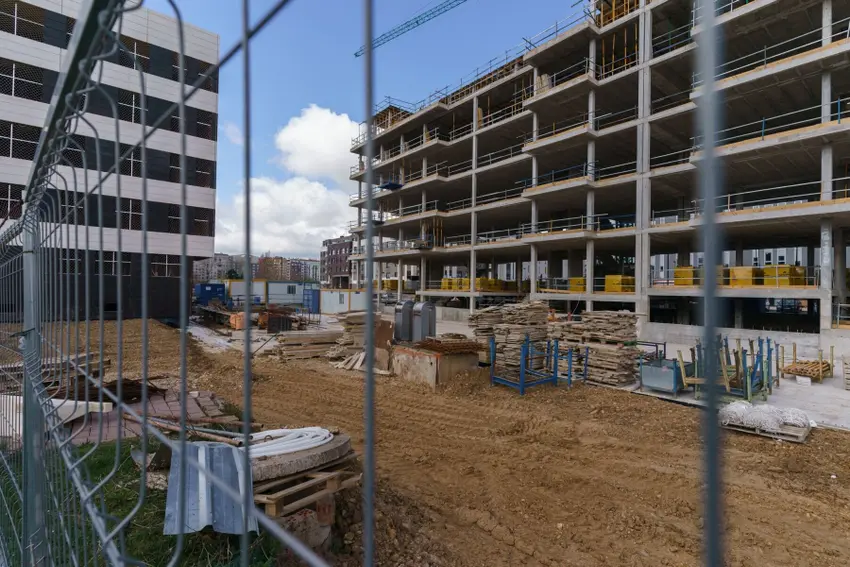
Housing shortages in Spain have contributed to steep price rises in recent years. This has been especially true in the rental market, where low supply and high demand have been compounded by an increase in short-term tourist rental properties.
Calculations from the Banco de España estimate that Spain will have a shortfall of 600,000 homes by 2025. This follows a long-term decline in property building. The number of properties built fell from a peak of 650,000 per year between 2006 and 2008 to a low of just 45,000 in 2016.
Those in the know, whether it be in construction, economics, or politicians across the political spectrum, all agree on what needs to be done: build more.
So why isn’t it happening? Although the Spanish construction sector does seem to be shifting into gear, or starting to, at least (data from Spain’s Ministry of Housing shows that 14.65 percent more licences were issued in the first seven months of 2024 than in the same period in 2023) experts warn that red tape and bureaucracy are holding back the industry from getting to where it needs to be.
READ ALSO: Rent in Spain's big cities now over €1,000 a month
Beatriz Toribio, general secretary of the Spanish Association of Construction Developers, told Spanish online outlet 20Minutos that, incredibly, paperwork can in some cases take longer than the building project itself: “It takes longer to develop land and manage licences than it does to build,” she says.
Toribio feels the government is not matching the private sector’s steps to speed up processes. “The private sector is speeding up the construction of housing, but the administration is not going at the same rate to speed up the focus of the problem, which is the management and development of land and all the bureaucratic procedures for granting licences,” she says.
Whether it be the healthcare system or making tax returns, Spain has something of a reputation for being an inefficient, overly-administrative country. In construction, before the first brick is even laid it can take years to secure the land on which to build, and then there are often further wait periods of over a year simply to get the proper licences to put tools in the ground.
Raymond Torres, economic director of Funcas, a socioeconomic think tank, feels that there's no shortage of land to build on: "the main stumbling block has to do with the allocation of building land. Spain is one of the least dense countries in Europe. There is an abundance of land, but it needs to be developed.”
In a bid to do this and free the sector from red tape, the Spanish government recently resumed reforms to land law to simplify urban planning rules and limit the number of legal challenges, introducing the possibility of correcting minor errors in applications that can leave building projects stuck in the courts.
The reforms were side-lined during Spain’s long run of elections in the last year and are yet to be voted on in the Spanish Congress. Prime Minister Pedro Sánchez’s Socialists (PSOE) are likely to face criticism from the right, by opposition Partido Popular, but also the left, from junior coalition partners Sumar.
One thing on which there seems to be consensus, however, is the need to speed up the granting of licences.
The government is reportedly working on creating simplified licensing models to decrease deadlines. The private sector seems supportive of this step: "The basic licence allows you to start the development process by obtaining the licence in months instead of taking more than a year. We can't wait longer to get a licence than it takes to build a house," Toribio says.
The current housing crisis highlights a deeper bureaucratic stagnation in Spain so entrenched that some fear it could even hamper the country’s future. A 2023 piece in La Razón put it bluntly: “Excessive bureaucracy threatens to paralyse Spain's modernisation.”
Spain’s incessant red tape and bureaucratic delays not only contribute to problems in the property market, small public works or local developments, but also holds back crucial reform on which the future of the Spanish economy depends, such as the deployment of renewable energies or the electrification of the transport system.
La Razón cited statistics that show the deadlines for granting licences in Spain are often three times the legal limit, but in some cases can even be ten times longer than they should be.
READ ALSO: The places in Spain where rents have more than doubled in a decade
Comments (2)