

As part of the Spanish government’s climate change and energy transition legislation, a series of low-emission zones (Zonas de Bajas Emisiones, ZBEs) have been created in some areas of the country in 2023 and more in smaller cities throughout 2024.
Spain wants to reduce air pollution in urban areas, and by 2050 have a fleet of cars and light commercial vehicles without direct carbon dioxide emissions, in line with the 2015 Paris Agreement.
These ZBEs affect cars that do not have an environmental label, so you need to be aware of what category you car falls into and make sure you have one of these stickers.
The zones will be in 149 municipalities in Spain with more than 50,000 people, as well as those with more than 20,000 inhabitants that exceed the maximum pollution levels.
Some municipalities have been quite slow to implement them, but it’s important to be aware of the rules as they do.
Despite the obvious good that they do, ZBEs are controversial, and many people are against them. Recently, in September 2024 the Madrid high court just cancelled three of its ZBEs due to a petition from the right-wing Vox party.
They are currently still in place until October 23rd, but the city council has 30 days in which to appeal the decision if it wants.
While they’re still in force in other areas of the country, the future of them is in jeopardy.
It’s important to check the details of the ZBEs in your area with the local town hall, to find out if and when they have been implemented.
These low-emission zones basically mean that vehicles that pollute the most will have restricted access and parking in urban areas. The ZBEs will be marked by signposts.
Stickers
Environmental emissions stickers (etiquetas ambientales) are now mandatory in Spain for all vehicles that want to circulate in low-emission zones.
According to Spain’s Directorate of Traffic (DGT,) the emissions stickers are a way of "classifying vehicles according to their energy efficiency and taking into account their environmental impact".
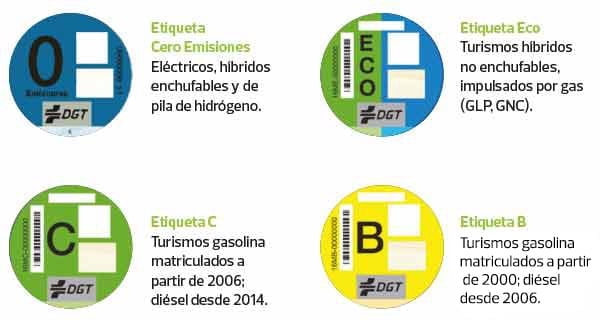
The DGT lists four environmental labels and categorises of vehicles according to their impact on the environment. These are:
- Zero (0) emissions (blue sticker): The most efficient vehicles, electric cars, hydrogen-powered cars and pluggable hybrids.
- ECO (green and blue sticker): Natural gas and hybrid vehicles.
- C (green sticker): Petrol cars and vans registered after January 2006, and diesel cars registered after January 2015.
- B (yellow sticker): Petrol cars and vans registered since January 2001, and diesel cars registered since January 2006.
Cars that are not eligible for a sticker are classified as ‘A’. These are petrol vehicles that were manufactured before 2001 or diesel vehicles made before 2006. They cannot be used in ZBEs because they pollute the air too much. But, classic cars classified as “históricos” will still be allowed in ZBEs.
So how can you get one of these stickers if you don’t already have one?
Details on how and where to get an emissions sticker
You will first need to check your car’s classification on the DGT website. Do this by entering your registration number and looking at the result.
When you know what classification you’re under, you can get your environmental sticker
Where to get environmental stickers for your car:
DGT
You can order them via the DGT mobile and tablet app.
Correos
Spain’s postal service Correos sells them for €5. You will have to bring your ID, driving licence and your vehicle’s documents.
You can also buy it online here, though there is a postal fee of €2.99.
Mechanic workshops associated with the Institute of Automotive Studies (IDEAUTO)
You can also get the tickets at different mechanics workshops across Spain. You'll need to take your registration certificate, ID, and pay €5.
CETRAA
Similarly, any CETRAA (Spanish Confederation of Automobile Repair Shops) affiliated workshop can sell the stickers.
Tobacco shops
You can also buy them at any official tobacco distributors. These also have a cost of €5.
GANVAM
GAVNAM, Spain's National Association of Motor Vehicles, Repairs and Spare Parts offers the labels for fleets of cars like taxi companies. Costs are between €6 to €10, depending on the number purchased.
By phone or in person
The stickers can also be ordered by phone by calling 060, or in person at any DGT traffic office.
If you need an emissions sticker, you should get one as soon as possible, because in some cities such as Barcelona, where have existed for a few years, you will be fined if you don’t have one.
Comments (1)