
What is it?
The invitation letter (carta de invitación in Spanish) is a form which can be asked for from non-EU nationals when entering Spain as a way of proving to Spanish border officers that they have a legitimate place to stay at in Spain and an address on record.
Note this is generally for people visiting to stay with friends and family who haven’t booked commercial tourist accommodation.
Non-EU nationals who either need or don't need a visa to enter Spain may be expected to produce it, but their ‘host’ or invitee must actually be the one to arrange and send it to them.
READ ALSO: Which nationalities need a short-stay visa for Spain?
It is not a requirement per se for non-EU nationals who don't have a hotel booking or other accredited accommodation, nor a replacement for any other required documents for entry, but according to Spain's Foreign Office "police controls can deny entry" for those on private or tourist trips if they can't produce "proof of lodgings or an invitation letter from an individual, if you're staying at their address".
Who can request it?
In a sentence: anyone who is legally living in Spain and wants to have a non-EU guest stay with them.
That means it could be a Spanish citizen, an EU citizen living in Spain, or a non-EU citizen legally residing in Spain with the proper residency permit to prove it.
The carta is requested by the person living in Spain on behalf of the guest, and must be sent to the guest to show on the border (more on that below).
How do I write one?
Though the name might suggest you actually write a letter yourself, the invitation letter is nowadays basically a legal form that you need to request at the police station.
You will need to fill out personal details of both yourself and your guest.
How long does it take to get an invitation letter for a visa?
As Spanish bureaucratic processes can be a bit unpredictable, it takes from 10 days to 2 months to get the invitation letter for a foreigner who wants to visit Spain.
Therefore, it's advisable to complete the application process at least a month in advance, if not two.
What do I need to bring with me to the police station?
There are several documents you’ll need in order to request the carta de invitación.
- Rental contract or house deed, if you own the property.
- A copy of your empadronamiento to prove you’re registered.
- Your Spanish ID or residency document, so a TIE, green certificate or DNI.
- The exact dates of the guest’s travel and stay, including flight details (it's important they have a return flight booked).
- A copy of their passport.
- The form to pay the fee, which must be paid.
To process the form it will cost you €75, then it will be a further €6.48 for the actual invitation letter, plus €1.08 for each extra document related to the application process.
This means it will likely work out to around €80 or €90, depending on how long they stay.
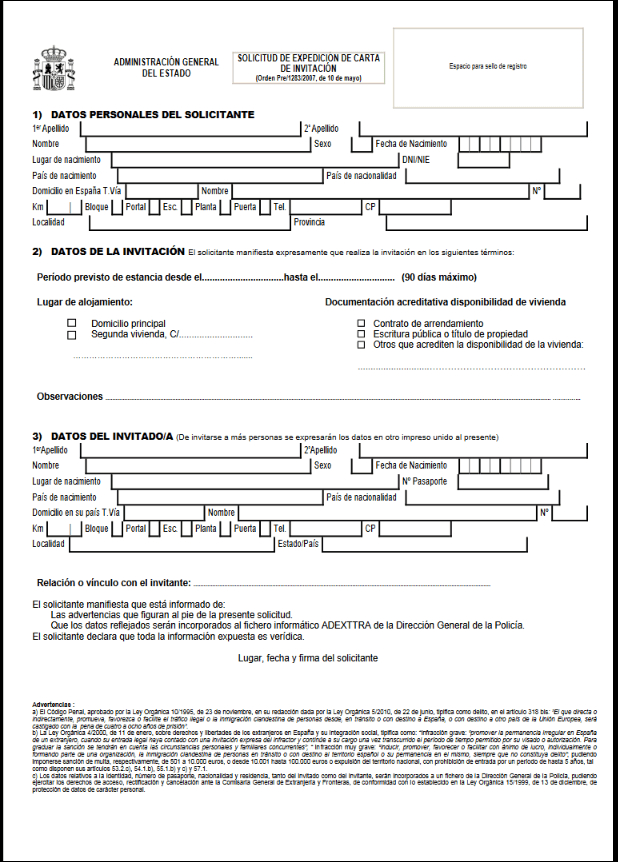
You can download the form you need here. Below is an example of what it looks like.
What should your carta de invitación include?
You’ll need details of both the host and guest, including:
- Name
- Proof of address
- Passport copy
- Residency status
- Contact info
- Employment details
- Relationship to guest/host
There will also be sections on the purpose of the visit itself, ie. businesses vs pleasure.
You’ll have to include the dates of their stay, and evidence of how you’ll cover the cost of the trip. For non-EU nationals it is currently €95 for every day they are in Spain.
The form will also require further supporting documents like the travel itinerary (including evidence of return flights) as well as the proof of accommodation and travel insurance.
Will Spanish border guards ask to see the carta de invitación?
It’s unlikely, but they could. If you don’t have any evidence of reservations in hotels or other tourist accommodation, and don’t have the carta, you could theoretically be denied entry in Spain.
For British tourists, Spanish border guards seem to have gone out of their way to make post-Brexit travel as smooth as possible to Spain. As far as The Local knows, and judging by Spanish media reports, the border authorities are not actively asking for the carta de invitación but just remember that in theory they could.
Comments (2)