
Passing the amnesty will be a key moment for Socialist Prime Minister Pedro Sánchez, as it was a demand made by separatist parties in exchange for their parliamentary support to allow him to serve a new term.
In March, Spain's lower house of parliament passed the bill, which grants an amnesty to hundreds of separatists involved in Catalonia's failed 2017 independence bid. It then went to the Senate upper house, which is dominated by the right-wing opposition, where it was vetoed in a symbolic gesture that won't stop it becoming law.
It returns to the 350-seat lower house on Thursday for a debate that begins at 9:00 am (0700 GMT) in which lawmakers will vote on lifting the veto then giving the bill its final green light.
READ ALSO: Thousands protest in Madrid over Catalan amnesty bill
The legislation seeks to draw a line under years of efforts to prosecute those involved in the botched 2017 secession bid that triggered Spain's worst political crisis in decades.
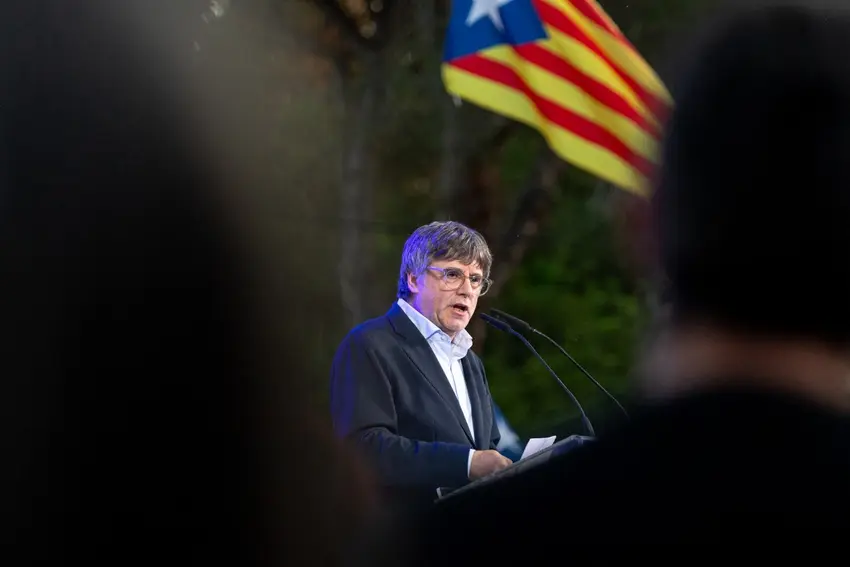
The biggest beneficiary will be Puigdemont -- the former Catalan leader who led the bid then fled Spain to avoid prosecution.
His hardline separatist JxCat and its moderate rival ERC both demanded the amnesty in return for their votes in November that let Sánchez secure another four-year term.
'Making a virtue of necessity'
What opened that door was Spain's inconclusive July 2023 election, which was won by the right-wing Popular Party (PP) but without enough parliamentary support to form a government.
With JxCat cast in the role of kingmaker, Sánchez won them over with the promise of an amnesty and returned to office, in a move sparking fierce and unrelenting opposition from the PP and the far-right Vox.
They have drawn thousands onto the streets in mass protests against the bill that at times turned violent, notably around the Socialists' Madrid headquarters.
The latest one was on Sunday when PP leader Alberto Núñez Feijóo again demanded Sánchez "withdraw the amnesty" bill.
On Tuesday, a PP spokesman said that even after the bill passes the party would do everything to "overturn" it, whether through appeals to the Constitutional Court or through "social pressure" on the street.
His critics recall that Sánchez himself had ruled out an amnesty while campaigning for last year's vote before parliamentary arithmetic forced him to change his stance to avoid calling new elections.
"We must make a virtue of necessity," Sánchez has said on many occasions to explain his U-turn.
Surveys suggest Spaniards are divided over the amnesty, even Sánchez's own Socialists and their supporters.
A two-month delay
However, the outcome of Catalonia's regional election on May 12, in which the Socialists won a clear victory, has shifted the picture.
The separatists lost their absolute majority in the Catalan parliament after 10 years in power, vindicating Sánchez's policy of seeking to defuse tensions triggered by the 2017 crisis.
READ ALSO: Politics in Spain: 8 things we learnt from the Catalan elections
The leader of the Socialist Party's Catalan branch, Salvador Illa, is hoping to lead the region's new government.
The results show that Catalonia has chosen "the path of forgiveness, giving up any kind of resentment", Sánchez said in Barcelona last week.
Puigdemont, whose party increased support during the vote and has said he wants to lead a minority separatist administration, is hoping to be home back in time to see a new Catalan government take office.
Although the date has not yet been set, it is expected to take place by June 25 at the latest.
But it is unclear whether that will be possible.
Once the law passes, the courts will have two months to enact the legislation, releasing those behind bars and cancelling outstanding arrest warrants, including the one for Puigdemont.
Comments