
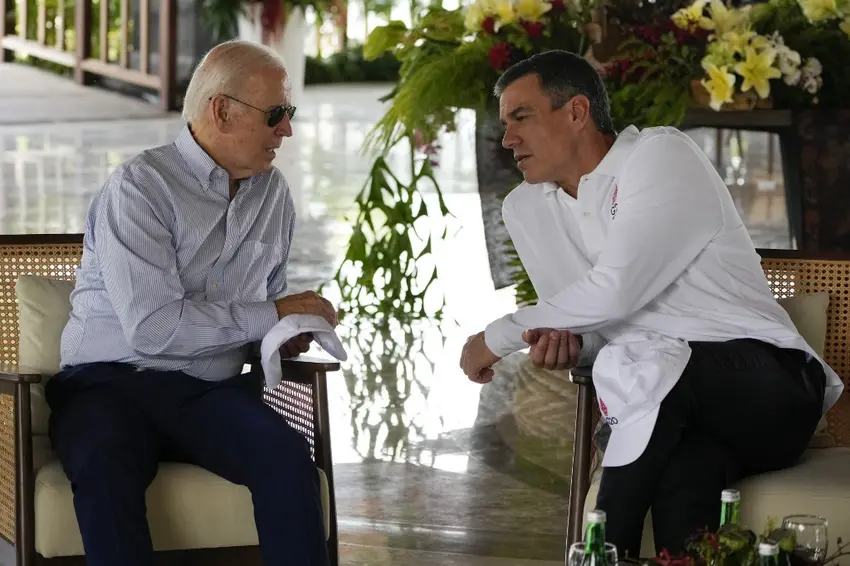
In November 2022, Spain's Prime Minister Pedro Sánchez was pictured among other world leaders at the G20 meeting in Indonesia.
La unidad de la UE y la OTAN es nuestra mayor fortaleza ante las consecuencias desencadenadas por la guerra injustificada provocada por Rusia.
— Pedro Sánchez (@sanchezcastejon) November 16, 2022
En el #G20 hemos compartido nuestra visión del mundo, nuestra agenda y la apuesta común por la paz. pic.twitter.com/tZ2S7Z8gkX
Photos of Sánchez alongside major world leaders, including US President Joe Biden, then-British Prime Minister Rishi Sunak, and French President Emmanuel Macron, were published around the world
Sánchez's place among these world leaders, and by extension Spain's position among the major superpowers, some say, confirms the country's place as a 'big' or 'important' nation on the global stage.
Similar pictures will no doubt emerge from next week's G20 summit in Rio di Janeiro, which the Spanish PM is once again scheduled to attend.
But the truth is that Spain is not in fact a member of the G20 group of countries.
What is the G20? (And why is Spain not in it?)
The G20, or Group of 20, is according to its own definition "the main international forum for economic, financial and political cooperation, it addresses the great global challenges and seeks to generate public policies that solve them."
The 20 countries making up the G20 are the US, UK, Germany, France, Russia, Italy, India, China, South Korea, Canada, Japan, Mexico, South Africa, Argentina, Brazil, Saudi Arabia, Mexico, Turkey, Australia, and this year's hosts, Indonesia.
Founded in 1999, the G7 countries were joined first by Russia and the 12 major emerging economies around the world.
As Spain was not among the world's major economies nor was it considered emerging, it was left out the group.
The group makes up around 85 percent of the global gross economic product, 66 percent of the world's population, 75 percent of its international trade, and 80 percent of global investments.
Nineteen of the G20 members are in the top 33 economies in the world, and Spain ranks at 14th of the 33, above bigger economies than G20 members Mexico, in 15th, Indonesia, 16th, Turkey 17th, Saudi Arabia 19th, Argentina 21st and South Africa in 33rd.
Spain has the fifth largest economy in the EU, it is the home of the language spoken by 8 percent of the world's population, according to the Cervantes Institute, and is the second most visited place on earth, attracting 83.5 million tourists a year.
But still, it is not in the G20.
So why is Spain always invited?
The 2008 financial crisis ravaged the Spanish economy and left it in over a half-decade of economic decline.
When the G20 met to address the impending global economic meltdown that year, Spain was not invited.
Yet, in the end José Luis Rodríguez Zapatero, Spain's Prime Minister at the time, was allowed to attend the summit after making an arrangement with the then French President Nicolas Sarkozy, who let Zapatero take one of the two seats France had at the summit due to Sarkozy being the rotating presidency of the EU at the time.
Since then, Spain has continued to attend the G20 summits as a 'permanent guest,' and is the only country with such status.
Will Spain ever join the G20?
Now that Spain has been a permanent member of the G20 for almost 15 years, it seems safe to say that the G20 will not increase its number of formal members anytime soon.
To do so, an existing member would have to removed - unless they want to change the name to G21, or G22 - and this seems unlikely because though there are countries with smaller economies than Spain, their membership of the G20 adds a geographic diversity to the policy making that another European nation like Spain would take away from.
That's not to say that it might not extend permanent guest status to other countries, however.
According to the Elcano Royal Institute, a Spanish think-tank focusing international and strategic studies, what Spain needs to do "to consolidate is its role as a permanent guest and eventually opt to be a member if the occasion arises... [is to] provide analyses, positions and proposals that interest it as a country and the other partners in this framework."
Comments